https://dh-choi.com/2025shanghai

1. Introduction

Joseon Dynasty's Examination System and Bureaucratic Structure

How many people passed the Gwageo examination?

Where they come from?

15th
16th
17th
18th
19th

Formation of Seoul

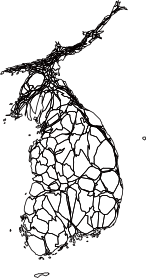
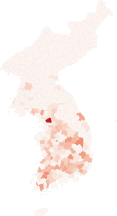
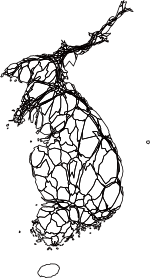
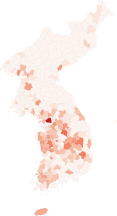
During the early days of the Joseon Dynasty, it is difficult for most regions to produce successful candidates. Entering the 15th century, there was a notable increase in the number of Gwageo examination candidates, especially from the Honam and Yeongnam regions.

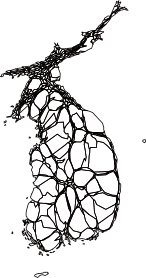
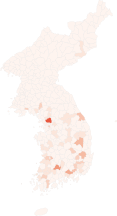
15th century cartogram A15th century cartogram B

16th Century

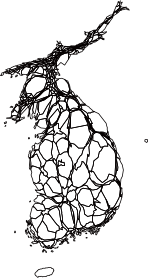
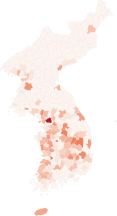
By the 16th century, the influx of Gwageo examinees from Seoul began to rise significantly

16th century cartogram A16th century cartogram B

17th Century

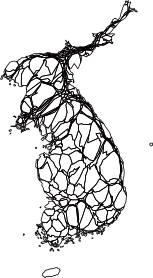
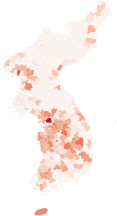
Seoul, Chungcheong, and Yeongnam continue to be major contributors to the number of Gwageo examinees.

17th century cartogram A17th century cartogram B

18th Century

In the 18th century, while the general trend stayed the same, the Pyeongan province started seeing a gradual increase in the number of successful candidates.

18th century cartogram A18th century cartogram B

19th Century

As the 19th century came around, the Pyeongan province started standing out. This surge was largely due to the province's economic development, driven by mining and commerce, and the boost in trade with the Qing dynasty.

19th century cartogram A19th century cartogram B

Gwageo and Kējǔ: A Comparative Perspective

  • Joseon's Gwageo examination system was modeled after China's imperial examination system (Kējǔ, 科舉)
  • Both systems served as meritocratic pathways into hierarchical bureaucratic systems with multiple ranks
  • Examinations tested classical literature, Confucian philosophy, and administrative knowledge
  • Passing the exam was only the beginning—actual career success depended on advancement through bureaucratic ranks over time
  • This study analyzes Joseon Korea's complete historical records to demonstrate high-resolution career trajectory analysis—a model for future research on Ming and Qing China when their records become fully digitized
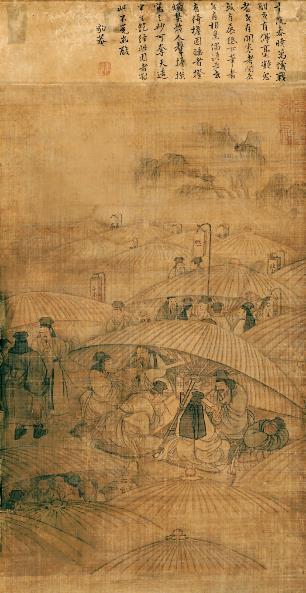
Joseon Gwageo Examination

Gong Won Chun Hyo Do (Gwageo examination scene) by Kim Hong-do (1745-1806), Ansan

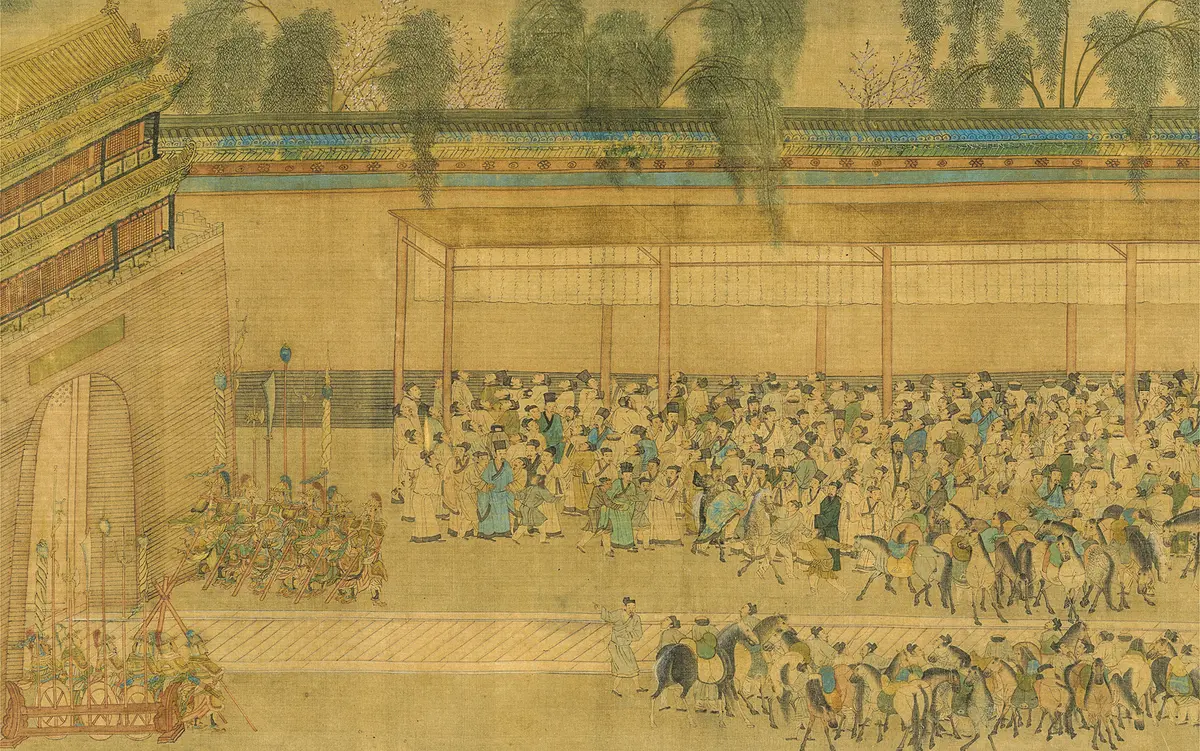
Chinese Kējǔ Examination

Excerpt from Viewing the Pass Lists, attr. to Qiu Ying (1494-1552). National Palace Museum, Taipei

Use arrow keys to navigate

Research Questions

  1. How do we quantify individual bureaucratic success?

    We need a systematic metric to measure career achievement beyond simply passing the examination.

  2. What questions can be answered through this quantification?

    Can we identify patterns of elite reproduction, social mobility, and institutional corruption over time?

2. Method

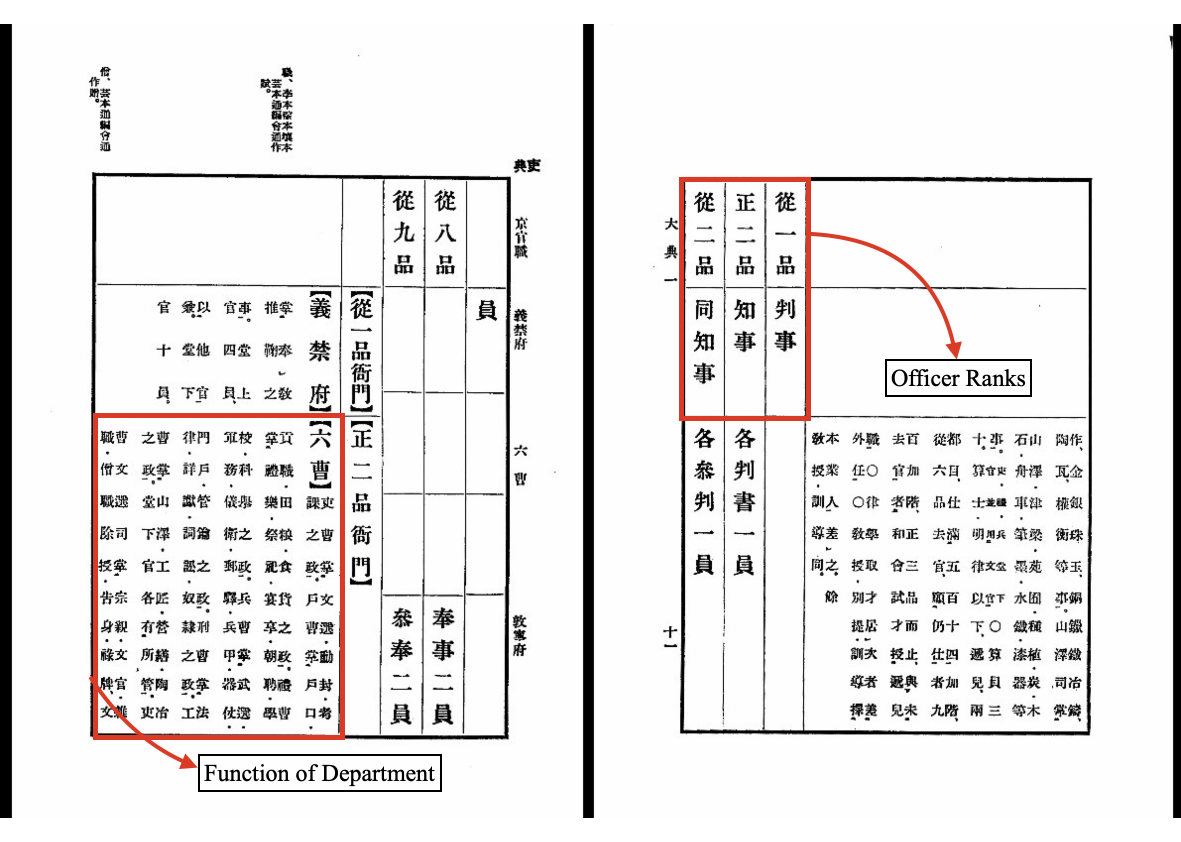
Official grade table

KoreanEnglishNumeric Value
정일품1st Rank18
종일품Junior 1st Rank17
정이품2nd Rank16
종이품Junior 2nd Rank15
정삼품3rd Rank14
종삼품Junior 3rd Rank13
정사품4th Rank12
종사품Junior 4th Rank11
정오품5th Rank10
종오품Junior 5th Rank9
정육품6th Rank8
종육품Junior 6th Rank7
정칠품7th Rank6
종칠품Junior 7th Rank5
정팔품8th Rank4
종팔품Junior 8th Rank3
정구품9th Rank2
종구품Junior 9th Rank1

Concept of Bureaucratic Success Index (BSI, ψ)

  • Success can be defined as “the real or perceived achievements that individuals have accumulated as a result of their work experience” (Judge, 1999).
  • We construct the Bureaucratic Success Index (BSI, ψ) by summing a bureaucrat's grade (r) over time. Since r=1 represents the highest grade and r=18 the lowest, we sum (19-r) so that larger ψ values indicate greater success. Because bureaucrats are mentioned in historical records at irregular intervals rather than uniformly fixed times, we calculate ψ as the area under the curve (AUC) connecting their recorded grades across appearances.
GradeTime151051PassingGwageoFirst appearance in AJDLast appearance in AJDAREA = BSI

Constructed Yangban Career Trajectories

yangban trajectories

3. Data

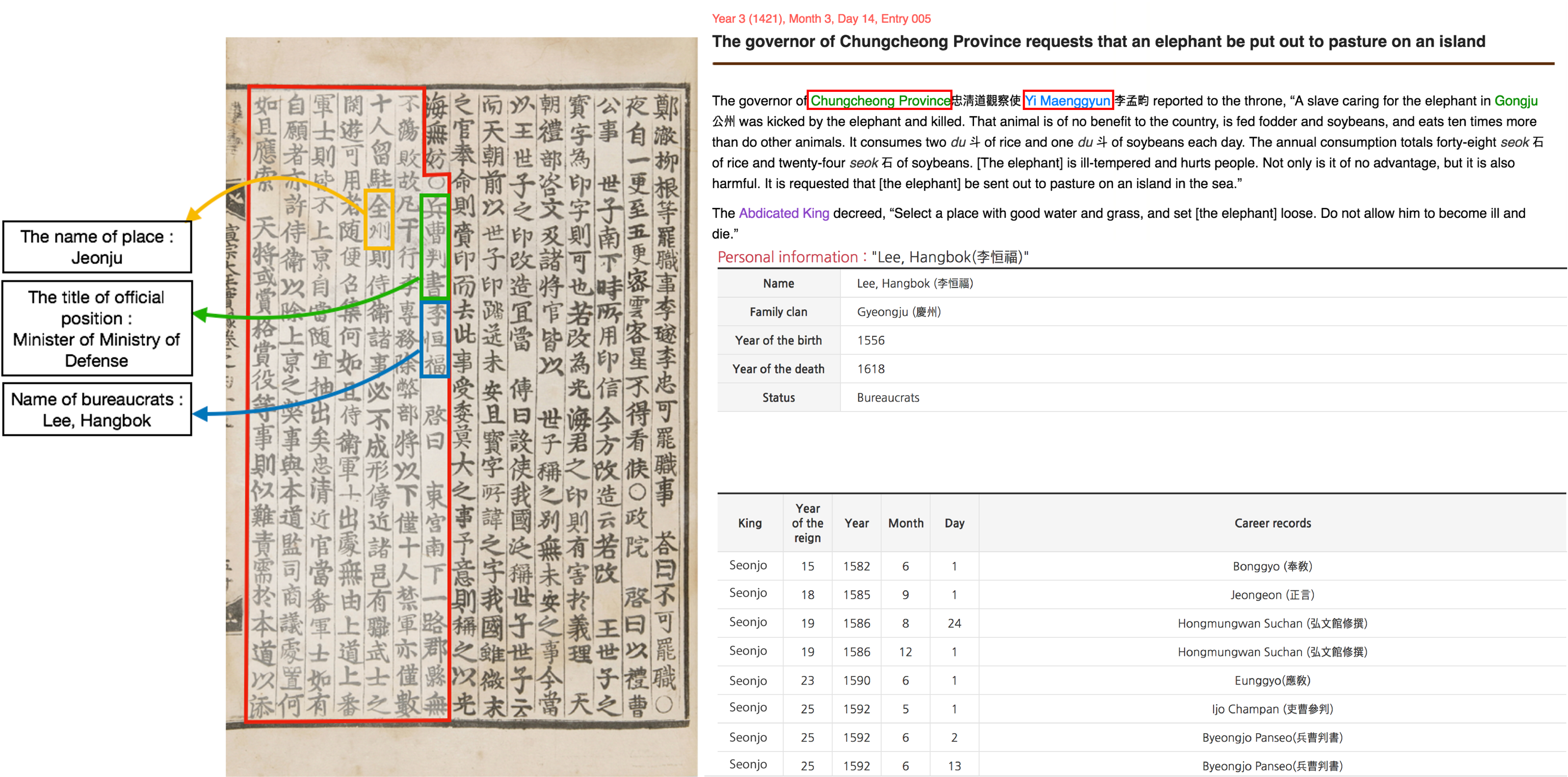
Annals of Joseon Dynasty
The Annals of Joseon Dynasty

A comprehensive chronological narrative documenting each king's notable actions and decisions regarding royal, economic, military, and administrative matters. These records are based on detailed minutes kept by sagwan (court historians) who maintained constant proximity to the king throughout his reign.

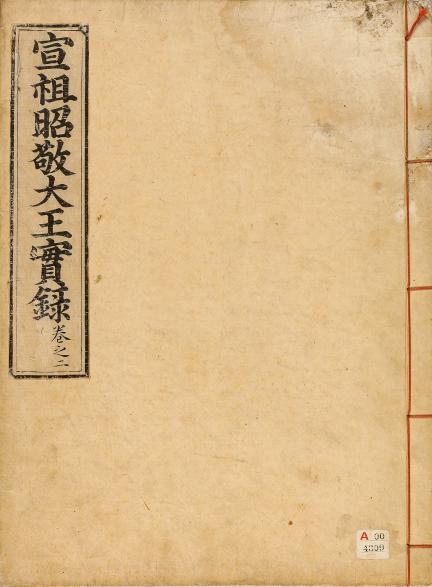
Mungwa Bangmok
Bangmok

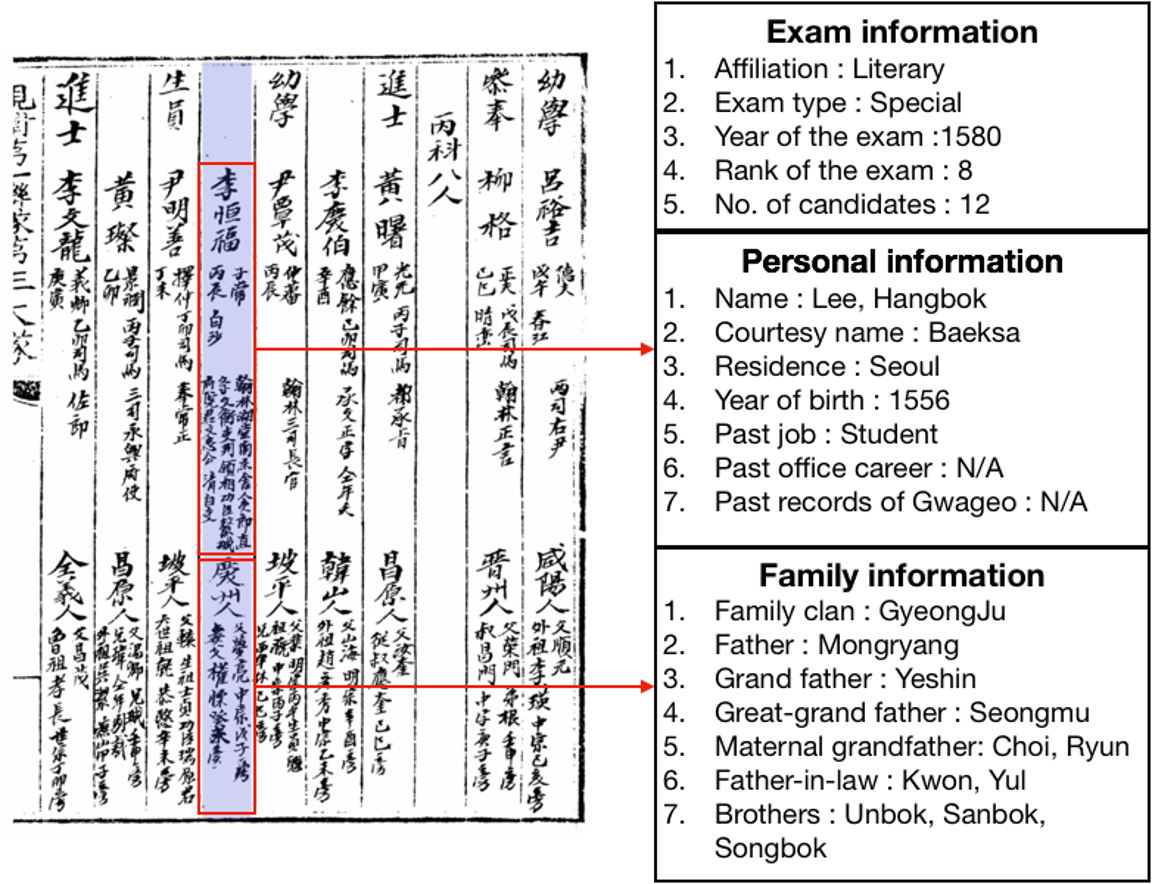
Official rosters listing all individuals who passed the Gwageo examination. Successful candidates collectively compiled these commemorative books to document their achievement. For the Mungwa (civil) examination, complete records from all test administrations throughout the dynasty have survived to the present day.

Gyeonggukdaejeon Ijeon
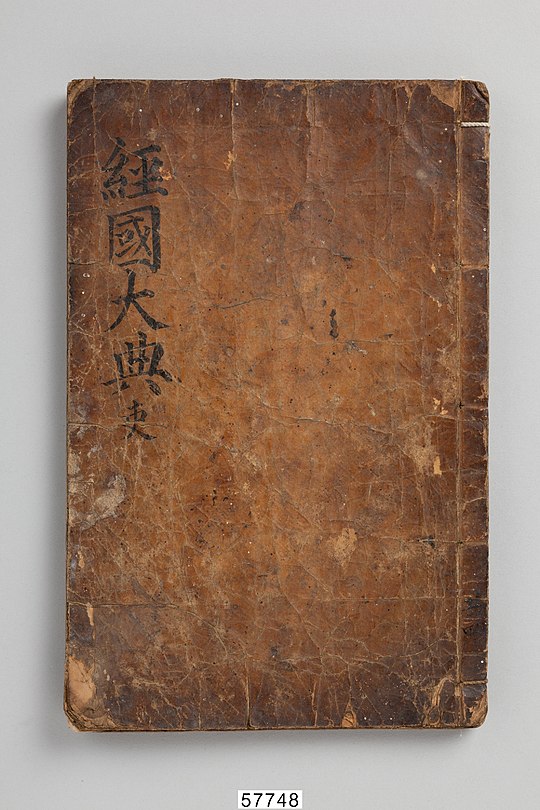
Gyeonggukdaejeon: Ijeon

The constitutional code of the Joseon Dynasty. The Ijeon (Personnel Statutes) section provides comprehensive regulations governing the civil service personnel system and bureaucratic organizational structure.
The Annals

Annals of Joseon Dynasty

The volume of the Annals

0

Monarchs

0

Topics

0

People appeared

0

Days (from August 5th, 1392 to August 14th 1894)

0

Articles

How many articles were produced daily by the king?

Constructing a social network and identifying key figures

Loading 3D network visualization...

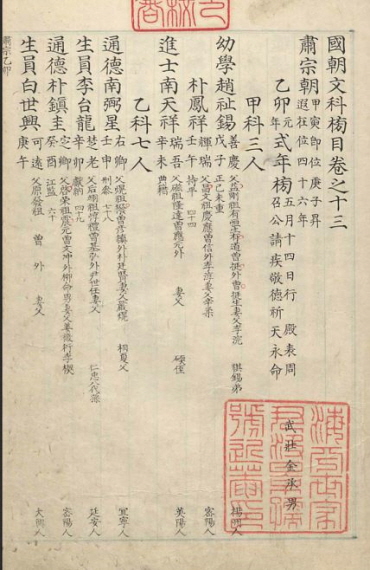
Mungwa Bangmok

Mungwa Bangmok

The Mungwa Bangmok contains the following information on each successful applicant:

  1. Exam information: Year of Gwageo, subtype of Gwageo taken, and initial rank, number of candidates
  2. Personal information: Name, residence, birth year, past positions (one can take multiple Gwageo exams for expedited promotions)
  3. Family information: Family clan, and the names of father, paternal grandfather, paternal great-grandfather, maternal grandfather, and brothers if they had passed Gwageo themselves
Affiliation of examNo. of exam conductionNo. of remaining Bangmok
Mungwa804804
Mugwa801138
Miscellaneous233177

Gyeonggukdaejeon: Ijeon

Gyeonggukdaejeon Ijeon

4. Result

TSI
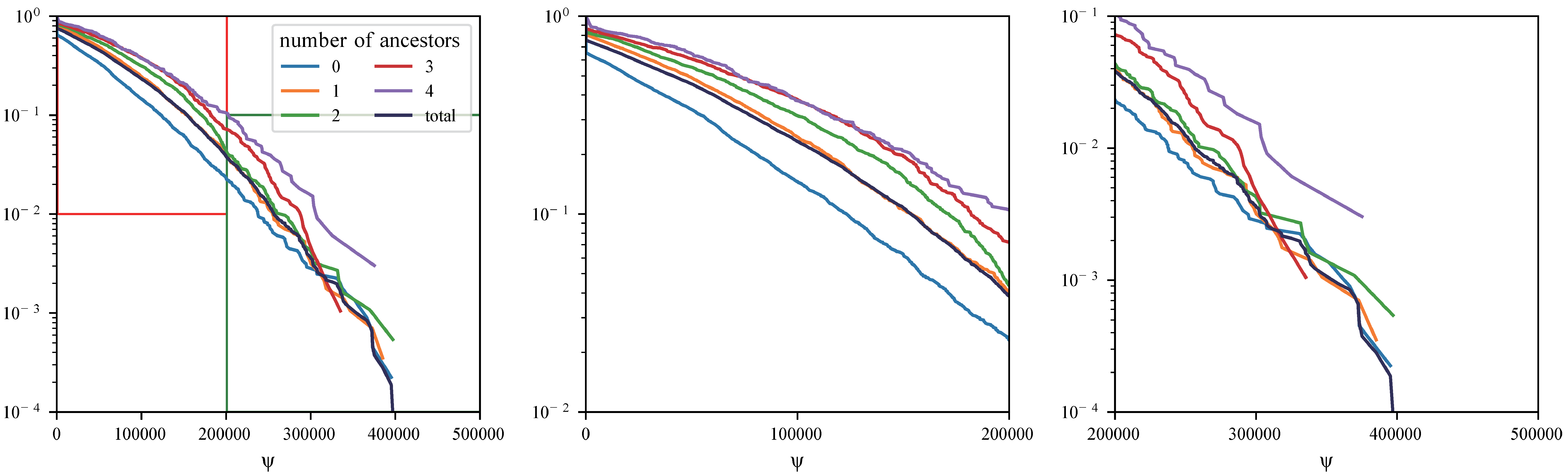
  • Yangban with more ancestors tended to have a higher BSI.

Uneven distribution of the success

  • The Gini inequality coefficient of ψ among Gwageo passers in the same year (bin size 30 years) shows a sudden sizable jump in the late 1800s.
  • An average Gini coefficient is 2.75-fold increased during its final decades in the 1800's.
  • A few family clans begin to gain power and dominate the bureaucracy, a sign of the corruption of the vaunted meritocracy of Joseon. Joseon meets its demise soon after in 1905 CE.

sedoga seized success

  • The emergence of sedoga (power-yielding family clans)--Yeoheung Min, Andong Kim, Pungyang Cho and BannamParks to name the best-known ones--that gained sway of the kingdom through successful marriages into the royal family.
  • The above plot shows the proportion of individuals from thesedoga who passed the Gwageo out of all those who did so in the past. As we approach the late Joseon period, their rate of passing the examination rapidly increases. This suggests that the Gwageo system is becoming corrupt.
  • The plot below illustrates the proportion of sedoga within the top 10% of the ψ value. Similarly, we can see a significant increase in this proportion as we enter the 1800s.

ψ heatmap

  • The heatmap provides an overview of this trend.
  • The x-axis represents time, while the y-axis indicates the deciles of the ψ value.
  • As the Joseon dynasty nears its downfall, we can observe that individuals from sedoga are increasingly concentrated in the higher ranks of the ψ value.

5. Conclusion

  • This research demonstrates high-resolution career trajectory analysis by introducing the Bureaucratic Success Index (BSI, ψ), which measures bureaucratic achievement beyond simply passing the examination.
  • Joseon Korea serves as a proof-of-concept for what becomes possible when complete historical records are digitized. With relatively smaller and more manageable datasets compared to Ming and Qing China, we reveal patterns invisible in previous research.
  • Key findings include the dramatic increase in BSI inequality during the late 1800s, with Gini coefficients increasing 2.75-fold, and the rising dominance of sedoga (power-yielding family clans) in both examination success and high BSI ranks—revealing institutional corruption before Joseon's collapse.
  • While Chinese Kējǔ records remain incomplete due to their enormous scale, this study demonstrates the analytical potential for future Ming and Qing research when their records become fully digitized, enabling comparative East Asian civil service examination analysis.

Thank You !

For enquiries, please contact:

[email protected]